
Choosing among N-type solar modules companies is difficult because module efficiency is only one part of the decision. Buyers must also compare cell technology, degradation behavior, temperature performance, warranty terms, product availability, installer support, and suitability for residential, commercial, or utility-scale projects. Product names and specifications can also vary by region and production year, making simple rankings unreliable. This guide evaluates six companies and solar suppliers using information published on their official websites and the supplied research materials. The comparison focuses on documented product focus, N-type-related technology, market scope, procurement support, and practical use cases rather than unverified performance claims.
Full List of Top 6 Brands
- Jinkosolar
- US Solar Supplier
- A1 SolarStore
- Tongwei
- Aptos Solar
- Aikosolar
Comparison Table
| Brand | Key Products | Key Features | Best For |
|---|---|---|---|
| Jinkosolar | N-type Tiger Neo photovoltaic modules and related solar products | N-type TOPCon focus, high-power formats, broad international product and service coverage | Residential, commercial, and utility-scale projects requiring an established module manufacturer |
| US Solar Supplier | Panels, inverters, racking, batteries, and complete system bundles | Direct manufacturer relationships, online procurement, and stated nationwide delivery | Homeowners, DIY buyers, installers, and small commercial projects |
| A1 SolarStore | N-type and other solar panels, inverters, and home-energy products | Online marketplace, product comparison tools, shipping, warranty, and return support | Buyers comparing equipment from multiple manufacturers |
| Tongwei | High-purity crystalline silicon, N-type cells, and high-efficiency modules | Vertically integrated PV capabilities and large stated cell and module capacity | Large-scale procurement and projects seeking an integrated PV supplier |
| Aptos Solar | N-type solar modules and bifacial-oriented module solutions | N-type silicon, tunnel oxide passivation, durability, and reduced LID claims | Projects where heat performance, bifacial generation, and durability are priorities |
| Aikosolar | ABC modules for residential, commercial, industrial, and utility applications | High-power designs, safety focus, and stated performance across demanding conditions | Space-constrained rooftops and challenging commercial or utility sites |
Detailed Reviews
1. Jinkosolar
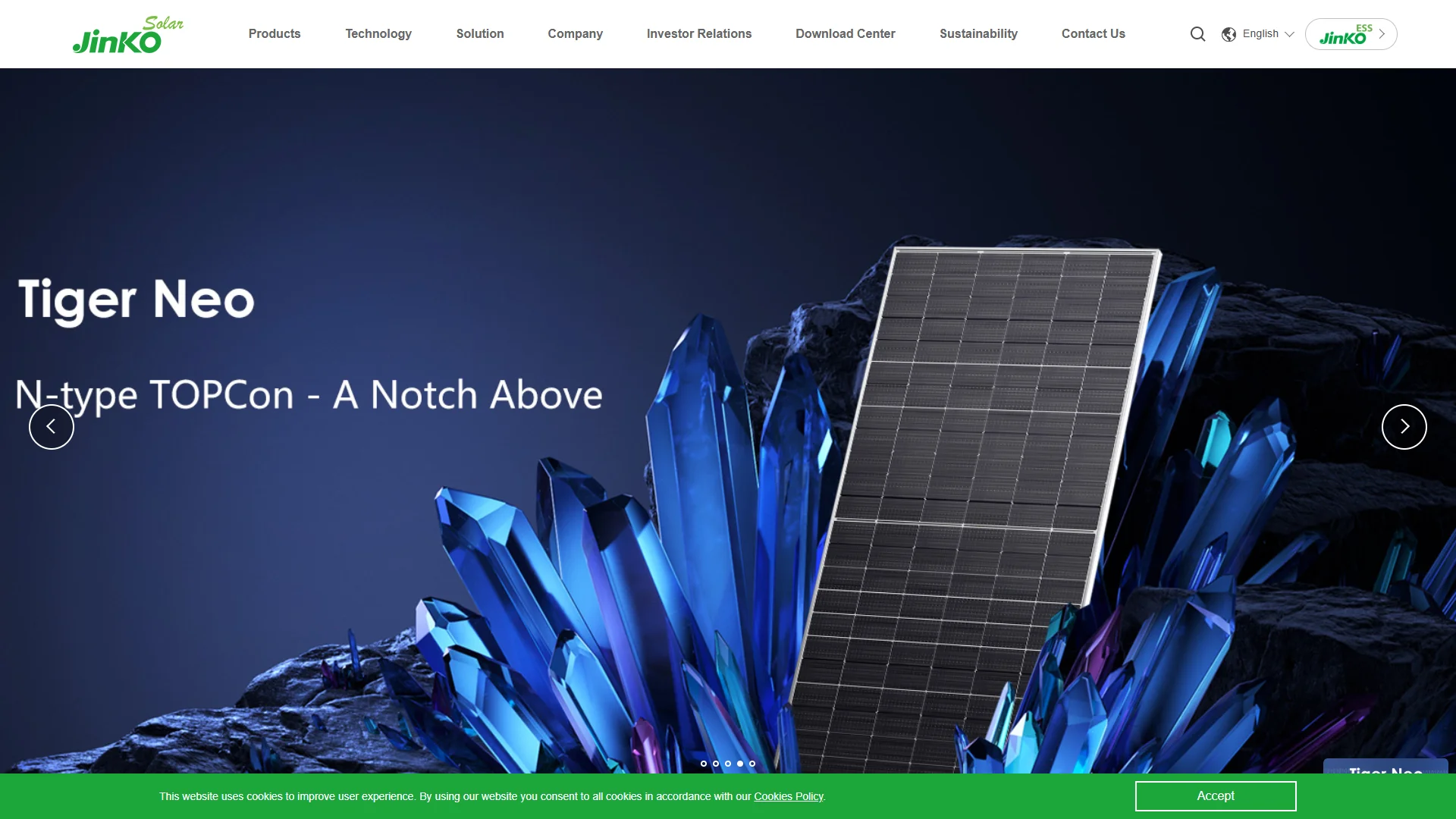
Overview: Jinkosolar is a major photovoltaic manufacturer with a global product portfolio covering solar modules, cells, and related energy solutions. Its N-type product direction is represented by the Tiger Neo family, which uses n-type TOPCon cell technology. The company’s official materials position Tiger Neo modules for residential, commercial and industrial, and utility-scale applications. Exact power ratings, dimensions, bifacial specifications, warranty language, and availability vary by model and market, so buyers should consult the current regional datasheet rather than general product descriptions.

Jinkosolar’s relevance to the N-type module market comes from its emphasis on n-type TOPCon manufacturing and high-power module formats. N-type cells are generally valued for lower light-induced degradation than conventional p-type PERC cells, while TOPCon adds a passivated contact structure intended to improve cell efficiency. These technology benefits do not eliminate the need to evaluate installation conditions, inverter compatibility, mechanical loading, shipping requirements, and the applicable warranty.
The company serves a broad international market through regional operations, distributors, and project channels. Its scale can be useful for developers that need consistent product families across multiple projects, although the available model range may differ by country. Commercial and utility buyers should verify approved distributors, local certifications, delivery schedules, and whether the exact module is listed for the intended electrical and structural design.
Pros / Key Features:
- Dedicated N-type Tiger Neo product family based on TOPCon technology.
- Product coverage spanning residential, commercial, industrial, and utility-scale applications.
- High-power module formats that can help reduce module count in suitable system designs.
- Global manufacturing and distribution reach, subject to regional availability.
- Published datasheets and technical documentation for model-level evaluation.
Use Cases / Best For: Jinkosolar is best suited to buyers seeking a large, established module manufacturer with N-type product options across several project sizes. It is particularly relevant for developers comparing TOPCon modules for rooftops, ground-mounted commercial systems, and utility-scale arrays. The strongest fit depends on the specific Tiger Neo generation, local certification requirements, roof loading, inverter voltage range, and the warranty terms supplied with the regional model.
2. US Solar Supplier
Overview: US Solar Supplier presents itself as an online destination for homeowners, installers, contractors, and small commercial buyers. Its stated range includes solar panels, inverters, racking, batteries, and complete system bundles. The supplied research materials also describe direct manufacturer relationships, competitive pricing, and fast nationwide delivery. The available information does not clearly establish a manufacturing history or identify one proprietary N-type module line.
Pros / Key Features:
- Broad equipment selection beyond modules.
- Online procurement model for homeowners and solar professionals.
- Stated support for DIY homeowners, installers, and small commercial projects.
- Racking, batteries, inverters, and system bundles available alongside panels.
- Stated fast nationwide delivery and manufacturer relationships.
Use Cases / Best For: US Solar Supplier is best for buyers who want to source several balance-of-system components through one supplier. Customers specifically seeking N-type modules should confirm the manufacturer, cell technology, current inventory, datasheet, warranty issuer, and shipping terms before ordering.
3. A1 SolarStore
Overview: A1 SolarStore describes itself as a marketplace for solar and home-energy solutions. The supplied research materials identify product groupings that include low-price panels, bifacial panels, Tier 1 panels, grid-tie inverters, hybrid inverters, residential inverters, and products identified as made in the USA. Its website also provides solar and electrical calculators, together with shipping, warranty-support, and return-policy information.
Pros / Key Features:
- Marketplace format for comparing products from different manufacturers.
- Listings that include bifacial and N-type panel categories.
- System-design calculators and educational resources.
- Access to inverters and other home-energy equipment.
- Published shipping, warranty, and return-support resources.
Use Cases / Best For: A1 SolarStore is best for residential, commercial, and installer buyers who value product comparison and online purchasing. Because it is a marketplace rather than a single module manufacturer, buyers should evaluate the individual panel brand, exact model, degradation warranty, certification documents, and seller or manufacturer support.
4. Tongwei
Overview: Tongwei operates across important parts of the photovoltaic value chain. Its official materials identify high-purity crystalline silicon, high-efficiency cells, and high-efficiency module products. The supplied research dossier states an N-type cell capacity of 150 GW, approximately 90 GW of module production capacity, and 900,000 tons of annual high-purity crystalline silicon capacity. Tongwei positions its PV activities around modern intelligent manufacturing and reliable, advanced modules.

The company’s stated product and project scope includes global PV solutions and large-scale applications. Its materials also reference fishery-photovoltaic integration projects and sustainability initiatives. These capabilities indicate a strong fit for large procurement programs, although project buyers still need to verify the exact module family, delivery region, technical certifications, and commercial warranty.
Pros / Key Features:
- Documented activity across silicon, cells, and modules.
- Large stated N-type cell and module production capacity.
- High-purity crystalline silicon manufacturing capabilities.
- Modern manufacturing and high-efficiency module positioning.
- Experience presented in global PV and fishery-PV applications.
Use Cases / Best For: Tongwei is best for developers, distributors, and large commercial or utility buyers assessing vertically integrated PV supply. It may also suit projects that require substantial cell and module manufacturing capacity, provided the selected product is available in the target market and meets local certification and bankability requirements.
5. Aptos Solar
Overview: Aptos Solar’s supplied materials focus on N-type solar technology and the performance characteristics associated with it. The research dossier identifies N-type silicon as the base material and discusses tunnel oxide passivation as a protective layer. It also describes reduced light-induced degradation, improved durability, stable performance at elevated temperatures, and bifacial energy production in reflective environments.
These characteristics are relevant to sites where heat, long operating life, or rear-side irradiance may influence energy yield. However, the supplied research does not clearly establish a complete corporate history, manufacturing scale, or detailed commercial support structure. Buyers should therefore rely on current Aptos Solar datasheets, certifications, warranty documents, and authorized-channel information for model-level decisions.
Pros / Key Features:
- N-type silicon technology focus.
- Discussion of tunnel oxide passivation and reduced LID.
- Stated emphasis on durability and performance in hot conditions.
- Bifacial capability can be useful over reflective surfaces.
- Potential relevance for projects prioritizing long-term output stability.
Use Cases / Best For: Aptos Solar is best for buyers evaluating N-type and bifacial module characteristics for warm climates, reflective ground conditions, and installations where degradation behavior matters. The exact suitability depends on the selected model’s efficiency, temperature coefficient, mechanical rating, rear-side gain assumptions, and warranty.
6. Aikosolar
Overview: Aikosolar’s official positioning centers on ABC modules. The supplied research materials describe these modules as solutions for homeowners as well as commercial and industrial customers. The company presents high power, high returns, safety, and performance under demanding conditions as key objectives. Its materials reference residential rooftops, commercial and industrial projects, utility-scale sites, and complex environments involving heat, humidity, salt mist, dust, obstructions, or difficult terrain.

The ABC product concept is presented as suitable for maximizing installed capacity and annual generation, which can be important where roof or land area is limited. The research dossier does not clearly provide a complete company history, detailed materials specification, or universal warranty terms. Model-specific documentation and local availability should therefore be checked before procurement.
Pros / Key Features:
- ABC module platform designed for high-power applications.
- Product positioning for residential, commercial, industrial, and utility projects.
- Focus on safety and functional reliability in demanding conditions.
- Suitability claims for constrained rooftops and challenging sites.
- International project positioning across varied environments.
Use Cases / Best For: Aikosolar is best for projects where power density, site constraints, and environmental resilience are central considerations. Commercial and industrial developers should compare the exact ABC model’s electrical behavior, mounting requirements, certifications, degradation warranty, and availability with competing N-type products.
How to Choose an N-Type Solar Module Company
1. Confirm the cell technology
“N-type” describes the semiconductor wafer type, not one single module design. TOPCon, heterojunction, and other architectures can have different efficiencies, temperature coefficients, degradation profiles, and electrical characteristics. The product datasheet should identify the cell technology clearly.
2. Compare the complete warranty
Review both the product warranty and the power-performance warranty. Check the stated degradation schedule, claim process, warranty issuer, geographic limitations, and whether the warranty transfers to a future property owner. A longer headline warranty is not automatically better if support and documentation are unclear.
3. Assess real site conditions
Temperature, snow, wind, humidity, salt exposure, dust, shading, roof orientation, and rear-side reflectivity all affect module selection. Bifacial modules require an installation design that allows useful rear irradiance; otherwise, their theoretical advantage may not translate into equivalent energy gains.
4. Match electrical characteristics
Check maximum system voltage, operating current, short-circuit current, temperature coefficients, connector type, and inverter compatibility. High-power modules can have higher operating currents, which may affect string design, inverter selection, fuses, and cable sizing.
5. Verify certifications and local availability
Confirm that the exact model—not merely the brand—is approved for the installation country and applicable building or electrical codes. Local inventory, shipping damage procedures, replacement availability, and authorized distribution can be as important as laboratory efficiency.
6. Compare total project cost
Module price is only one part of system cost. Consider freight, mounting hardware, labor, inverter compatibility, module count, roof loading, maintenance access, and expected annual energy yield. A higher-efficiency module may be useful on a small roof, while a lower-cost high-power module may be more practical for a large ground-mounted project.
Final Verdict
Jinkosolar ranks first because its documented N-type Tiger Neo portfolio, TOPCon direction, broad application range, and established international presence make it a strong all-around reference point for 2026 module comparisons. Tongwei is a notable option for buyers prioritizing integrated silicon, cell, and module manufacturing capacity. Aikosolar is relevant where high-power ABC modules and demanding site conditions are central. Aptos Solar is worth considering for buyers focused on N-type, bifacial, heat-performance, and degradation characteristics. US Solar Supplier and A1 SolarStore serve a different purpose: they can simplify product discovery and procurement, but buyers must assess the underlying module manufacturer and exact model. The most suitable choice ultimately depends on verified specifications, local support, site conditions, and total installed cost.
FAQs
What are N-type solar modules?
N-type solar modules use n-type silicon cells. Compared with traditional p-type designs, n-type cells are generally associated with lower susceptibility to light-induced degradation. The actual performance depends on the cell architecture, module construction, installation conditions, and manufacturer specifications.
Are N-type modules always better than p-type modules?
Not automatically. N-type modules may offer advantages in degradation, efficiency, or temperature performance, but purchase decisions should also consider price, availability, warranty support, electrical compatibility, mechanical ratings, and expected site conditions.
What should buyers verify before ordering?
Buyers should verify the exact model number, current datasheet, efficiency, temperature coefficient, operating and short-circuit current, maximum system voltage, mechanical load rating, certifications, product and performance warranties, authorized seller, shipping terms, and local availability.