
4 b2b order fulfillment services You Should Know
The Hook
Choosing among b2b order fulfillment services is difficult because providers rarely have identical operating models. One may focus on a China-based 3PL relationship, another on a technology-led fulfillment network, and another on a centrally located U.S. warehouse. Differences in inventory control, retail preparation, integrations, delivery coverage, product handling, and support can materially affect costs and service levels. The “best” option therefore depends on order volume, sales channels, product requirements, and geographic priorities rather than on a single universal ranking. This guide evaluates four supplied options using available company information and client-provided positioning. The comparison emphasizes documented capabilities and clearly distinguishes confirmed service features from information that should be verified during the buying process.
Full List of Top 4 Brands
- Lansil Global
- Flow
- ShipBob
- GoSquare1
Comparison Table
| Brand | Key Products | Key Features | Best For |
|---|---|---|---|
| Lansil Global | China-based 3PL and order fulfillment support | Designed for established ecommerce businesses; does not provide dropshipping | Stable-volume businesses seeking a China-based fulfillment partner |
| Flow | Outsourced fulfillment and warehousing support | Unified logistics platform, order changes before packing, custom rules, kitting, lot tracking, and network-based fulfillment | Brands scaling across ecommerce channels and markets |
| ShipBob | Omnichannel fulfillment, warehousing, picking, packing, shipping, and returns | In-house technology stack, 50+ fulfillment centers, integrations, API access, and automated delivery-method selection | Scaling brands needing broad fulfillment-network coverage |
| GoSquare1 | Pick-and-pack fulfillment, warehousing, kitting, sourcing, and retail shipments | Central U.S. location, same-day fulfillment, temperature-controlled storage, FBA/FBM preparation, and REST/EDI support | Consumer-product brands requiring U.S. fulfillment and specialized handling |
Detailed Reviews
1. Lansil Global
Overview
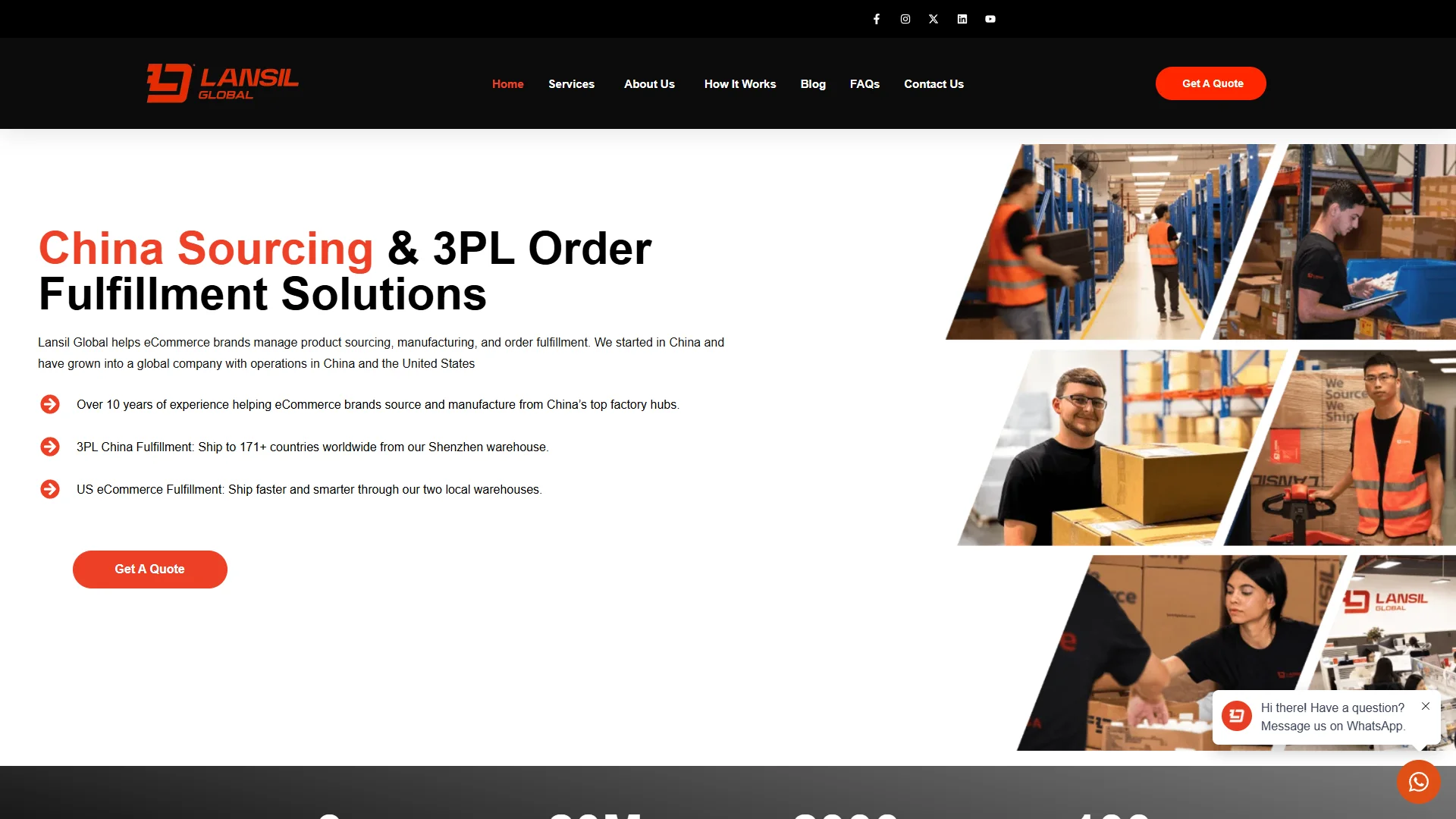
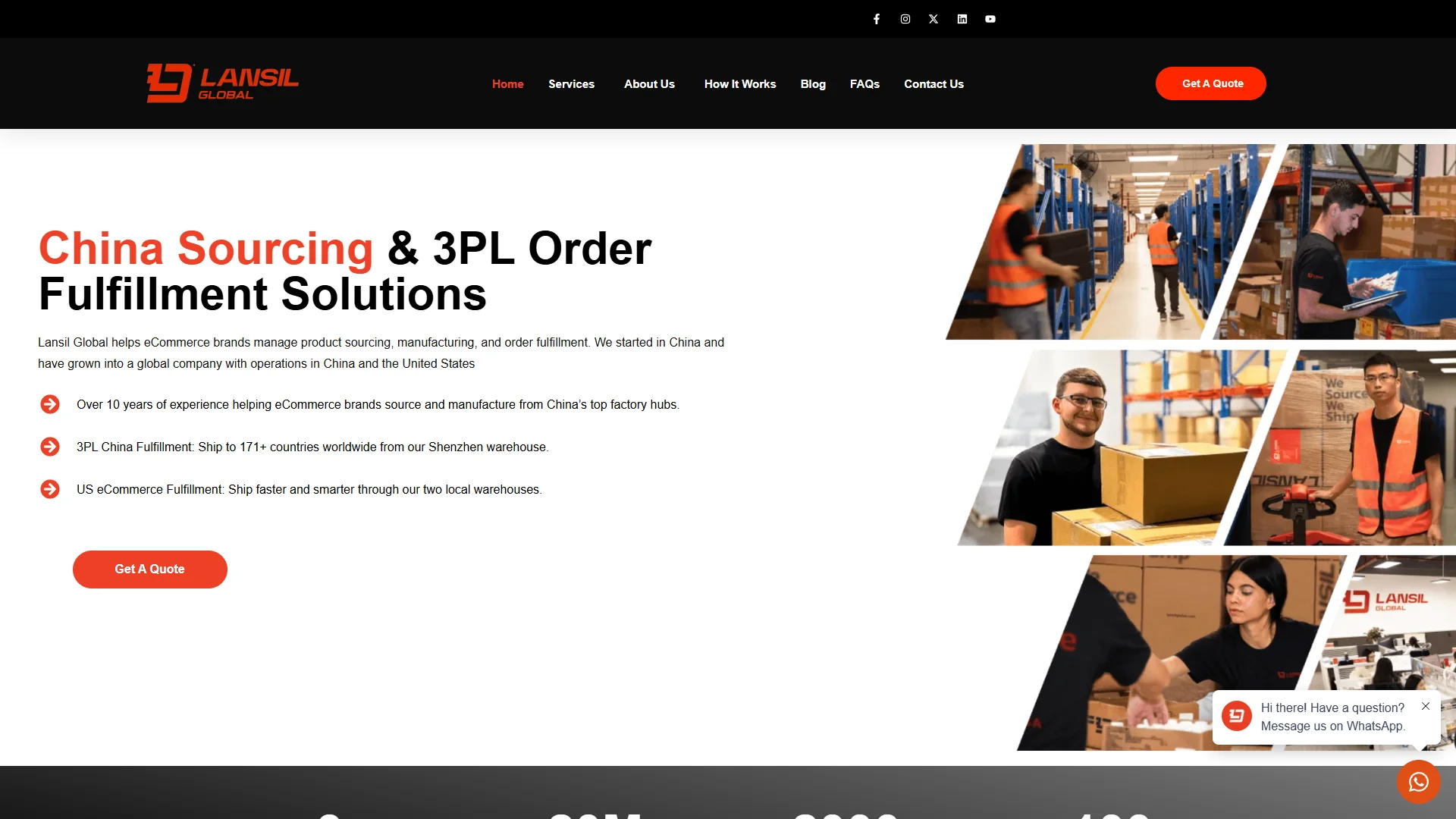
Lansil Global is positioned as a China-based 3PL partner for established ecommerce businesses with stable order volume. Its stated target customers are companies seeking to improve product quality or scale order volume through a China-based logistics relationship. Lansil Global does not provide dropshipping and is not positioned as a service for early-stage startups. This makes its scope different from providers that emphasize flexible, technology-led fulfillment for a wide range of emerging brands.
Products and Service Scope
The available positioning identifies Lansil Global with China-based third-party logistics and order fulfillment support. Specific product categories, warehouse locations, integrations, pricing, certifications, packaging options, and delivery-time commitments are not established in the supplied evidence and should be confirmed directly with the company.
Pros / Key Features
- Focused on established ecommerce businesses with consistent order volume.
- China-based 3PL positioning may be relevant to businesses operating within or sourcing from China.
- Positioned to support order-volume expansion and product-quality improvement.
- Does not offer dropshipping, which may suit businesses seeking a conventional fulfillment partnership rather than a dropshipping model.
- Potential buyers can clarify the operational scope, service levels, inventory processes, and integration requirements before contracting.
Use Cases / Best For
Lansil Global is best suited to established ecommerce companies that have predictable order volume and want a China-based 3PL relationship. It may be a relevant option for businesses evaluating how fulfillment operations can support larger volumes or improved product quality. It is not the appropriate fit for a company specifically seeking dropshipping or an early-stage service model.
Competitive Considerations
The primary differentiator in the supplied positioning is customer fit: Lansil Global is aimed at stable-volume ecommerce operations rather than broad, entry-level fulfillment demand. Because detailed operational claims were not provided, buyers should request information about warehouse facilities, inventory visibility, shipping lanes, returns, quality-control procedures, packaging, systems integration, and commercial terms.
2. Flow
Overview
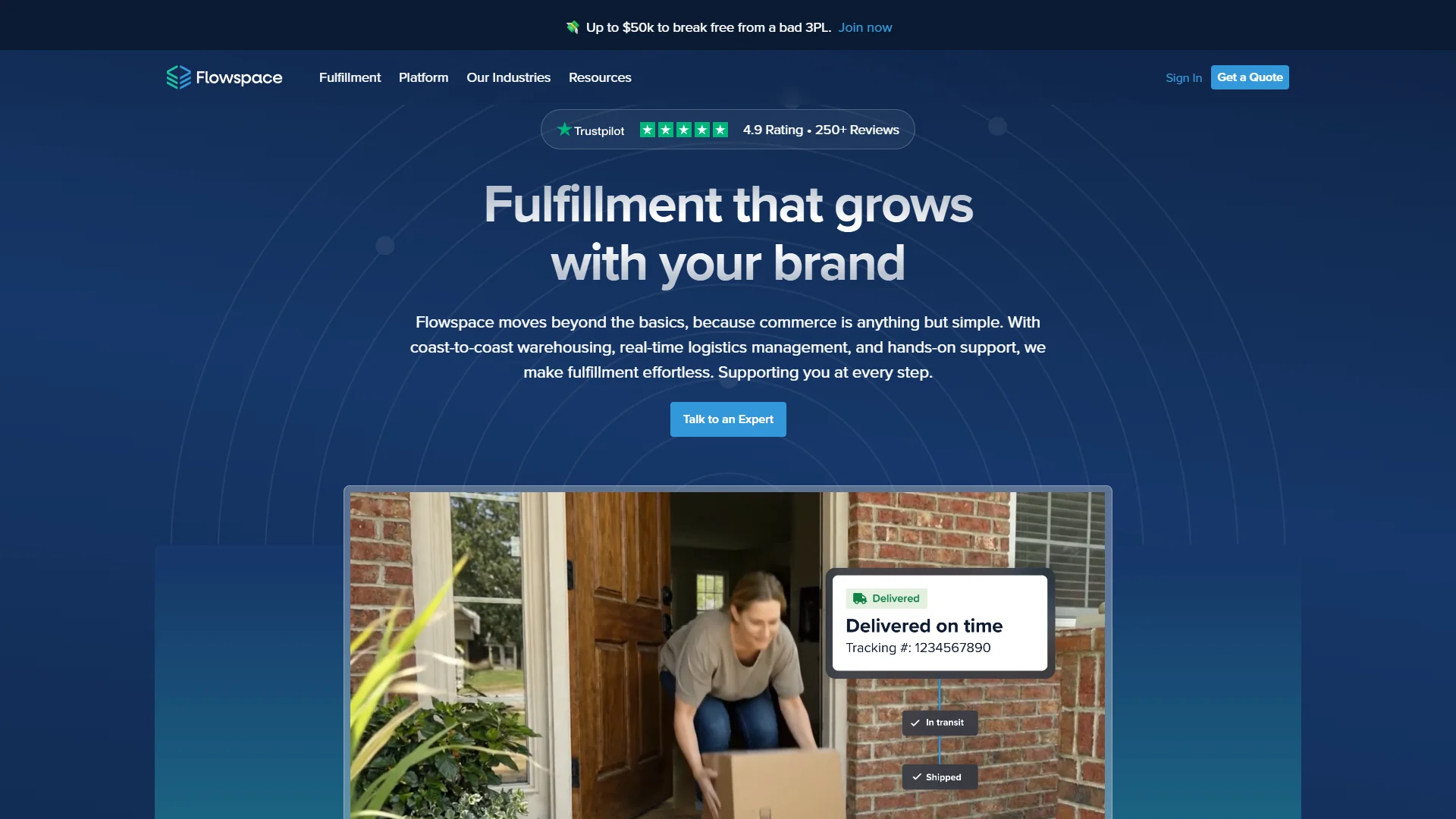
Flow presents a technology-supported fulfillment model designed to help brands scale operations and simplify logistics. Its supplied materials describe a unified platform for operational tasks, specialist support, and fulfillment across markets and sales channels. The company also states that it can support brands without long-term contracts or hidden commitments, although commercial terms should be verified for a specific account.
Pros / Key Features
- Unified platform intended to streamline fulfillment operations.
- Order changes can be enabled up to the packing stage.
- Custom rules can be created for operational or customer-experience requirements.
- Supports custom packaging and on-demand kitting in relevant use cases.
- Provides lot tracking and FDA-registered or FDA-certified storage references for certain product categories.
- Uses a fulfillment network intended to move inventory closer to customers and manage shipping rates.
Use Cases / Best For
Flow may suit brands that need outsourced fulfillment across ecommerce channels and markets, particularly businesses that value platform visibility, operational rules, kitting, or specialized inventory handling. The supplied evidence also references centralized DTC and B2B fulfillment supporting retail expansion. Companies should confirm the exact warehouse network, integrations, service-level commitments, and product eligibility.
3. ShipBob
Overview
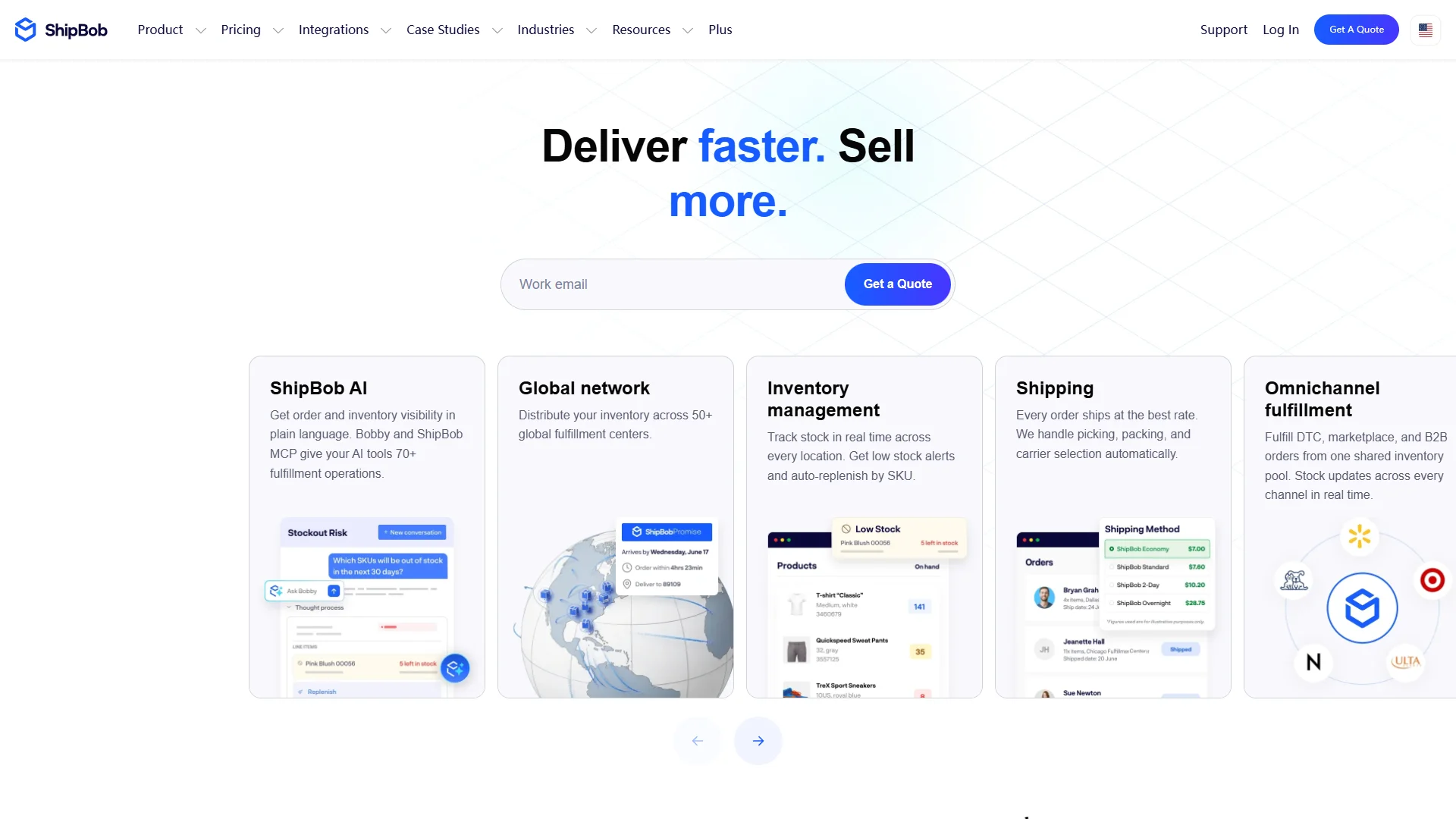
ShipBob describes an all-in-one fulfillment partnership for scaling brands. Its supplied company information states that its technology stack and data network have been built and operated in-house since 2014. The service scope includes fulfillment from an online store to the customer, retail support, marketplace activity, and omnichannel or global capabilities.
Pros / Key Features
- Fulfillment network covering more than 50 fulfillment centers, according to the supplied materials.
- Picking, packing, shipping, returns, and inventory-management support.
- Warehouse management technology that can select delivery methods.
- Inventory splitting across fulfillment centers to help manage transit times and shipping costs.
- More than 50 few-click integrations are referenced, along with a developer-oriented API.
- Support for retailers, automated EDI, online marketplaces, and other sales channels.
- Brand-consistency and unboxing options are part of the stated positioning.
Use Cases / Best For
ShipBob may be suitable for growing brands that need a distributed fulfillment network, broad ecommerce integrations, retail or marketplace support, and scalable shipping operations. Its network model differs from a single centrally located warehouse or a China-focused 3PL relationship, so businesses should compare inventory placement, regional coverage, fees, and international requirements before choosing.
4. GoSquare1
Overview
GoSquare1, also referred to as Square1 in the supplied research, operates a centrally located U.S. fulfillment model. Its materials describe a Missouri warehouse serving ecommerce brands nationwide. The company positions this central location as a way to balance transit times and carrier costs without requiring brands to manage multiple warehouses.
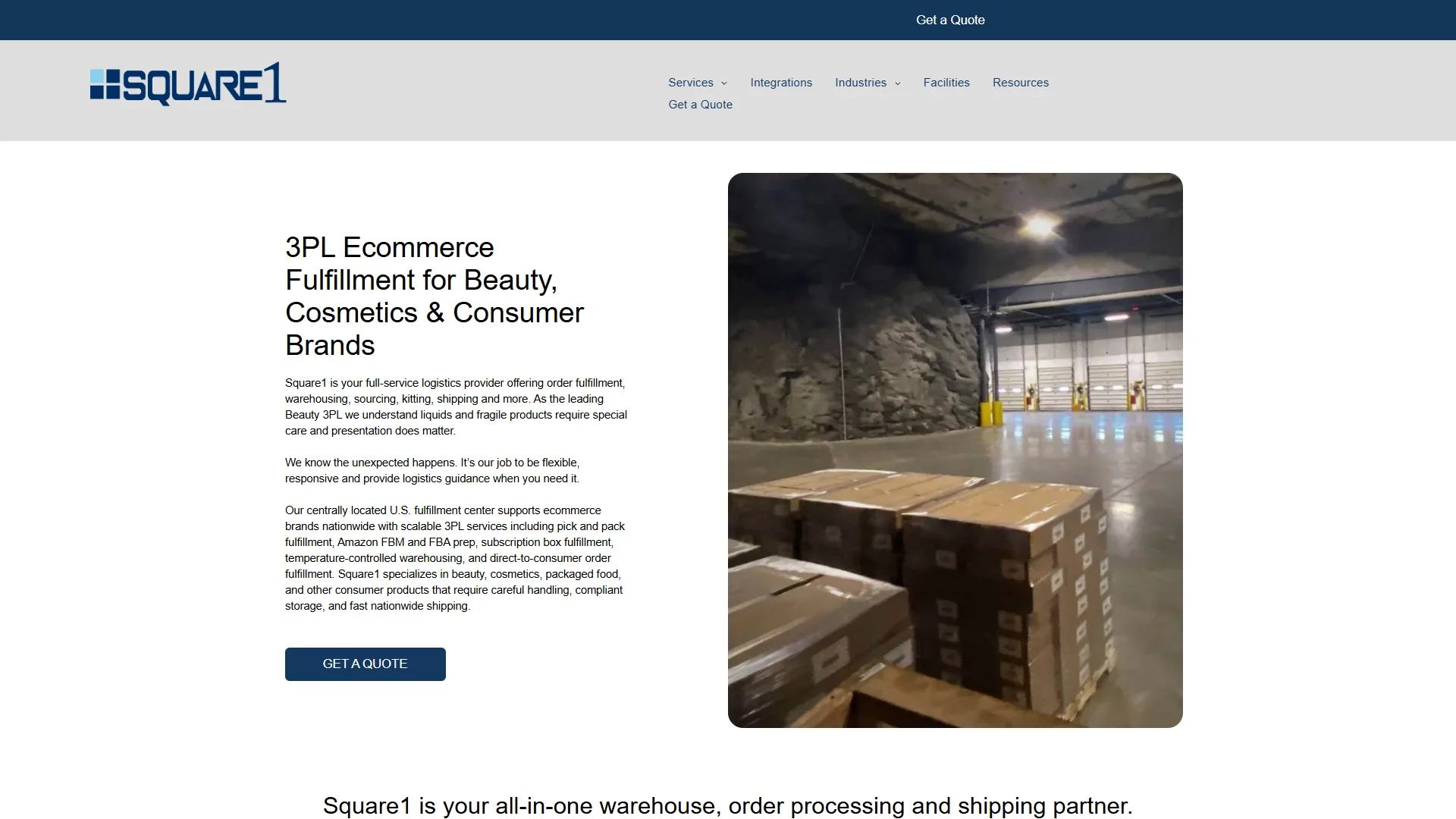
Pros / Key Features
- Same-day pick, pack, and ship capabilities are described in the supplied materials.
- Central U.S. warehouse coverage, with stated one-day delivery reach in several surrounding states and two-day delivery reach across parts of the Midwest and South.
- Pick-and-pack fulfillment, warehousing, sourcing, kitting, and shipping services.
- Amazon FBM and FBA preparation support.
- Subscription-box fulfillment and direct-to-consumer order fulfillment.
- Temperature-controlled warehousing for certain beauty, liquid, packaged-food, and fragile products.
- REST and EDI support, custom development for platforms without standard connectors, and retail-ready labeling.
- Support for both individual ecommerce orders and larger distributor or mass-retailer shipments.
Use Cases / Best For
GoSquare1 may be a strong fit for U.S.-focused ecommerce and consumer-product brands that value a central warehouse, same-day processing, retail preparation, or specialized storage. Its stated experience with beauty, cosmetics, packaged food, liquids, and other products requiring careful handling may be relevant to brands with those requirements. Buyers should verify temperature controls, integration scope, geographic service levels, and pricing for their specific inventory profile.
How to Choose a B2B Order Fulfillment Service
- Match the operating model to the business. Determine whether the company needs a China-based 3PL, a distributed fulfillment network, or a centrally located U.S. warehouse.
- Confirm volume requirements. Ask about minimum order volumes, onboarding requirements, peak-season capacity, storage limits, and support for predictable or variable demand.
- Review channel compatibility. Check support for ecommerce platforms, marketplaces, EDI, retail accounts, APIs, wholesale orders, and direct-to-consumer transactions.
- Evaluate inventory controls. Important questions include lot tracking, expiration management, cycle counts, returns, damaged inventory, stock alerts, and reporting access.
- Compare product-handling capabilities. Businesses selling food, liquids, beauty products, or fragile goods should verify temperature control, compliance processes, packaging, and handling procedures.
- Measure delivery economics. Compare warehouse locations, carrier options, zones, delivery promises, split-inventory policies, surcharge handling, and international shipping coverage.
- Examine integrations and implementation. Request a list of supported platforms, API documentation, EDI capabilities, onboarding steps, testing procedures, and expected implementation timelines.
- Understand the complete cost structure. Obtain itemized pricing for receiving, storage, pick and pack, packaging, kitting, returns, account management, technology, freight, and special handling.
- Check contract and support terms. Clarify commitments, termination provisions, account-management coverage, escalation procedures, service-level agreements, and peak-period policies.
Final Verdict
There is no single best provider for every B2B fulfillment requirement. Lansil Global is the most relevant option for established ecommerce businesses seeking a China-based 3PL relationship and should not be evaluated as a dropshipping service. Flow is oriented toward technology-led, adaptable fulfillment across channels and markets. ShipBob is designed for scaling brands that may benefit from a broad fulfillment-center network, integrations, and omnichannel support. GoSquare1 is differentiated by its central U.S. warehouse, same-day processing, retail preparation, and specialized handling options. The final decision should be based on verified pricing, inventory requirements, order volume, channel integrations, geographic coverage, and contract terms.
FAQs
What are B2B order fulfillment services?
B2B order fulfillment services outsource activities such as inventory receiving, storage, order processing, picking, packing, shipping, returns, and sometimes retail or wholesale preparation. The exact scope varies by provider and customer requirements.
Which listed provider is best for a China-based 3PL relationship?
Lansil Global is the listed provider specifically positioned as a China-based 3PL partner for established ecommerce businesses with stable order volume. Its detailed operational scope should be confirmed directly before engagement.
Should a small startup choose any of these services?
Suitability depends on volume, product type, budget, and service requirements. Lansil Global is specifically positioned for stable-volume businesses and does not encourage cooperation with early-stage startups. Other providers may have different onboarding and volume policies, so prospective customers should request qualification criteria and a detailed quote.